The built environment has made real progress on operational carbon. Smarter building systems, better monitoring, greener energy sources — the tools exist, and the adoption is growing. But there’s another carbon problem the industry has been slower to confront: the emissions embedded in a building’s materials before a single occupant walks through the door.
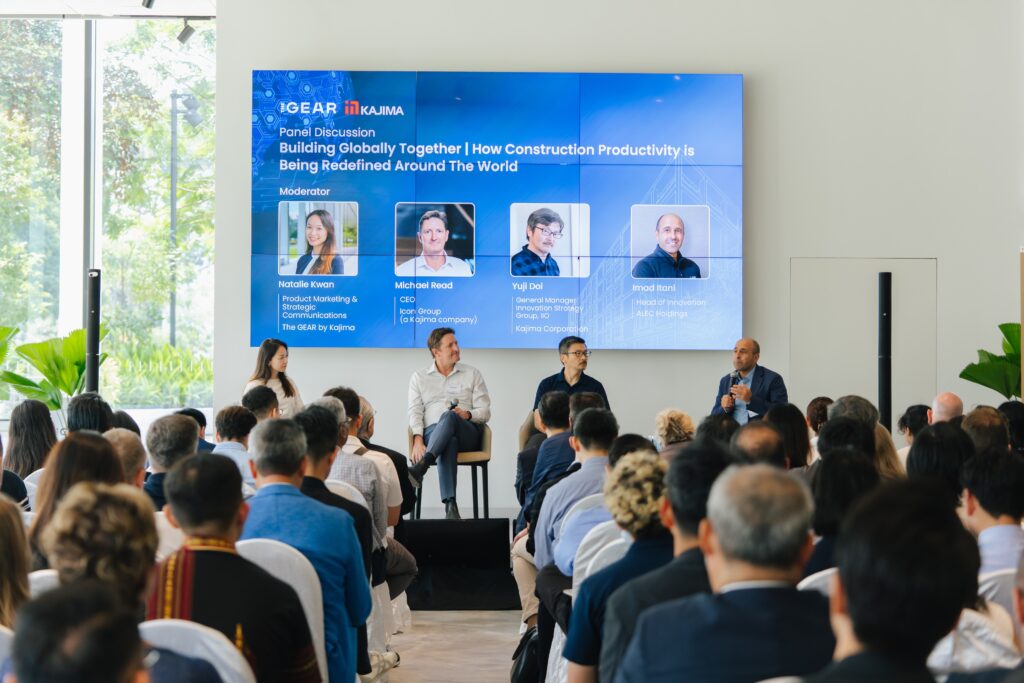
As part of The GEAR by Kajima’s recent industry event, titled “Breaking Ground on Sustainable Materials”, we invited industry experts, academia, startups and government together to explore the challenges, opportunities and projection on the future of sustainable materials.
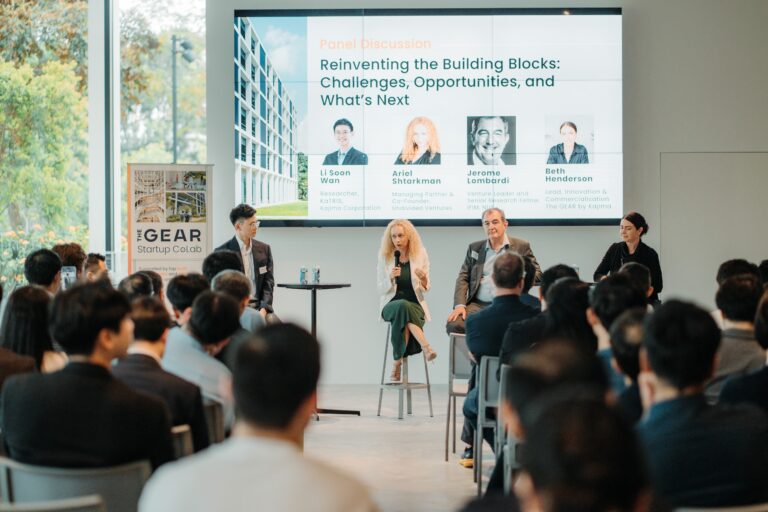
As Beth Henderson, Innovation & Commercialisation Lead of The GEAR, noted while moderating the panel discussion, the industry’s focus must shift: “As buildings become more energy efficient, the carbon locked into a building’s concrete, steel, and glass can now outweigh everything that a building will consume in energy across its entire lifetime, making early specification decisions more important than ever.”
So why aren’t we moving faster?
The technology is not the bottleneck
The most widely adopted low-carbon concrete solution available today — GGBS, ground granulated blast furnace slag (a by-product of steel production) — was first identified as a cementitious material in the 1860s, and used commercially in Europe by the early 1900s. With over a century of evidence the industry is still cautious about whether it’s safe to specify. Through The GEAR, we aim to push the barrier by working with the ecosystem to translate technologies into scaled commercialisation.
Throughout Kajima’s history, innovation has been ingrained in our DNA, and we are constantly striving to develop technologies that move the market. For example, Kajima together with partners, developed a GGBS-based concrete mix with up to 65% GGBS content — with rapid early-stage strength development and minimised shrinkage. This has been used across Kajima’s Japan projects for over a decade and is now being introduced to Singapore. In Japan, Kajima is also involved in running Cem R3, a technology that extracts reusable cement from returned or waste concrete, currently operational at return concrete plants in Japan. This demonstrates that circularity in concrete is no longer a remote concept, but a proven, functional process.
The ecosystem is ready too
What’s striking is how much innovation is already sitting at the edge of adoption, waiting for the industry to say “yes”. At The GEAR, we are partnering with diverse material-tech solution providers to test and carve out clear adoption plans.
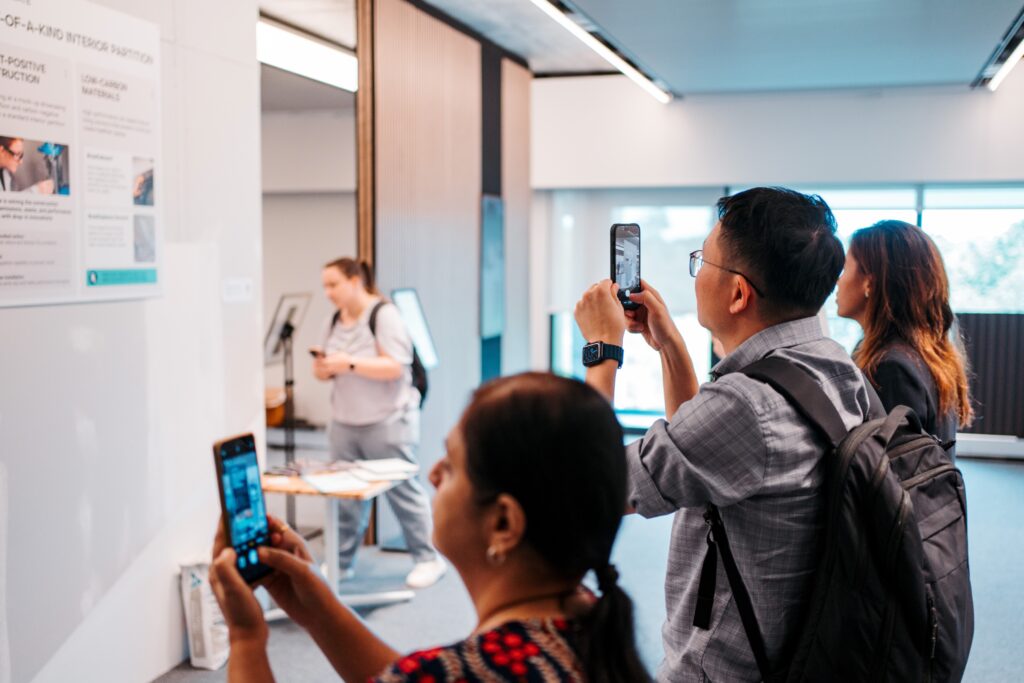
For example, Adaptavate has developed a bio-based wallboard that replaces conventional plasterboard with materials derived from agricultural waste, offering lower embodied carbon with comparable fire resistance and acoustic performance. Another startup, O.Space, is rethinking the interior wall entirely, reconfigurable, structurally sound, fire and acoustically rated, no demolition required when a floor plan needs to change. We have now deployed first-of-its-kind installations of both solutions at The GEAR building, which we see as just the starting point for supporting further uptake of these types of materials.
Looking to the coating space, the range of what’s now deployable is significant, and we are currently working with a series of exciting innovations in this space. Thermalytica’s paint solution targets up to 25% energy savings for a building. Aethify reduces AHU energy use by up to 12% through motor coatings. Feynman Labs increases solar panel output through coatings that cut dirt adhesion and improves light absorption. These are three different problems with three deployable solutions that can truly transform the industry, forging the future in sustainable materials.
However, technical readiness is only half the battle. Even with the technology in place, panellist Ariel Shtarkman, Managing Partner & Co-Founder, Undivided Ventures shared that, “Long sales cycles are the biggest hurdle. For materials startups, early support in navigating enterprise procurement is often as critical as funding itself.”
What actually needs to change
Singapore’s Green Plan 2030 is four years away. BCA has named its priority materials, alongside the release of Singapore’s first market-wide carbon benchmark for concrete. For the first time, developers can compare mixes by carbon intensity and procure accordingly.
As panellist Jerome Lombardi, Venture Leader and Senior Research Fellow of National University of Singapore pointed out, “Low-carbon adoption needs practical solutions. Innovative new cement binders from wasted metal slags and mine tailings show promise, but change only happens when they integrate smoothly into current workflows.”
What’s lagging is the willingness to use these tools. To specify a material that isn’t the “default”, to run a pilot that carries perceived risk, and to share results openly, even inconclusive ones, so the whole industry can learn faster and grow together.
Kajima’s “Tree and Forest” philosophy offers a longer-horizon reference point. Kajima owns and manages over 5,500 hectares of forest across 49 locations in Japan, with timber harvested for structural use in our own projects. Our cross-laminated timber solution (fire and earthquake resistant) will be used in our new Tohoku branch office as the first implementation of a wooden seismic control system, built to skyscraper standards. That’s a 1000-year view on the timber supply chain. Imagine the scale of shift we could see if concrete manufacturing took the same approach.
Finally, it is essential to also note the importance of resilience in the new materials conversation. True innovation is not just about reducing carbon, but about ensuring that the materials of tomorrow possess structural endurance to outlast the challenges of a changing climate.
As we reconsider how we build in the future, we must acknowledge that the cheapest build today could be the most expensive one to maintain tomorrow. As Wan Li Soon, Researcher, Sustainable & Resilient Infrastructure, Kajima Technical Research Institute Singapore (Kajima Corporation), shared during the panel discussion, “Resilience is often overlooked. Planning for resilience from the start is far more cost-effective than responding to emergency repairs later.”
The next generation of construction materials are already here. These solutions do not need another decade of R&D; they need an industry willing to treat specification as a lever for change, rather than just a risk to be managed. While the ecosystem has built the policy architecture and benchmarks for concrete in Singapore, the time has come for industry-wide adoption. The tools are proven. Now it falls to all of us — developers, contractors, designers, engineers and innovators — to pilot with courage, share with generosity, and forge together a built environment that future generations will be proud to inherit.
End of the article.